
 Skip to content
If a root canal is what’s needed to save your tooth, the Estero Bay Dental team will surprise you with an experience that is a lot less unpleasant than you may expect. With today’s tools and techniques, your experience getting a root canal will typically be very similar to getting a tooth filled.
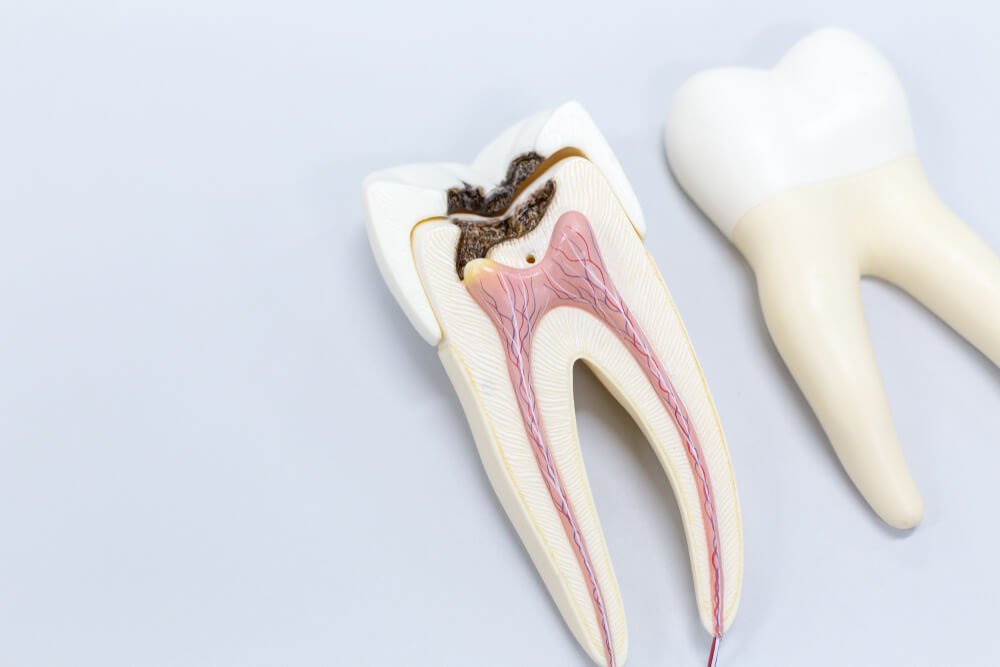
Estero Bay Dental provides root canal therapy to patients in Estero and Bonita Springs, with Dr. Ivan Vigoa working to relieve tooth pain, treat infection, and save your natural tooth whenever possible.
A toothache that will not quiet down, especially one that gets worse with hot or cold, often means the nerve inside the tooth is infected. Left alone, that infection can spread toward the jawbone and put the tooth itself at risk.
At Estero Bay Dental, Dr. Ivan Vigoa, whose training includes endodontics, performs root canal therapy designed to remove the infection and save your natural tooth whenever possible.
Each tooth has a soft inner layer called the pulp, which contains nerves and blood vessels. When decay, a crack, or a failing old filling lets bacteria reach the pulp, it can become inflamed and infected. Root canal therapy removes that infected pulp so the outer structure of the tooth can be cleaned, sealed, and returned to normal use.
If a root canal is what is needed to save your tooth, our team works to make the experience a lot less unpleasant than you may expect. With today’s tools and techniques, getting a root canal will typically be very similar to getting a tooth filled.
Watch for the following signs that a tooth’s nerve may be infected.
If you notice any of these signs, the sooner we examine the tooth, the better the chance of saving it. We offer same-day emergency appointments, so you do not have to wait with a painful tooth. If you are not sure what is causing your pain, we are also happy to provide a free second opinion.
A root canal at Estero Bay Dental typically follows four steps.
Research supported by the National Institute of Dental and Craniofacial Research continues to improve the materials dentists use to fill and seal a treated tooth.
Before root canal therapy became widely available, a diseased tooth usually had to be removed. Here is how the two options compare today.
| Consideration | Root Canal Therapy | Extraction |
|---|---|---|
| Natural tooth | Saved and restored | Removed permanently |
| Bite alignment | Stays unchanged | Neighboring teeth may shift |
| Next steps | Filling or crown only | Often needs an implant or bridge |
| Where it is done | In-house at our Estero office | In-house at our Estero office, see our extractions page |
We will always walk you through both options so you can make the choice that fits your tooth and your goals.
Mild soreness for a few days is normal and can usually be managed with over the counter pain medication. Avoid chewing on the treated tooth until any temporary filling or crown is finished, and continue brushing and flossing as usual. Adult teeth do not need their pulp to function, so with regular care your restored tooth can last a lifetime.
| After Treatment | What We Suggest |
|---|---|
| Soreness | Mild soreness for a few days is common and can usually be managed with over the counter pain medication. |
| Chewing | Avoid chewing on the treated tooth until any temporary filling or crown is finished. |
| Home care | Keep brushing and flossing as usual. |
| Follow-up | Keep your regular exams and cleanings so we can check the tooth. |
| Concerns | Call us if pain or swelling gets worse instead of better. |
Estero Bay Dental accepts several PPO insurance plans, and our team will review your benefits with you. If you have no insurance, our Smile Program is a discount program that includes a 15 percent discount on root canal therapy and oral surgery. We accept CareCredit and work with several financing partners, including Cherry Financing, to provide flexible options for paying the cost of treatment over time. We also offer a free second opinion if you would like another perspective before moving forward with treatment.
Our Estero office at 21740 S Tamiami Trail #111 welcomes patients from Estero, Bonita Springs, and nearby neighborhoods such as Pelican Landing, Pelican Sound, and Coconut Point. We are open Monday through Thursday from 8 am to 5 pm and Friday from 8 am to 1 pm, and our team speaks both English and Spanish. Root canals and endodontic retreatment are both done in-house.
Here are answers to the questions we hear most often about root canal therapy.
With today’s anesthesia and techniques, most patients say the procedure feels similar to getting a filling. Our Estero Bay Dental team uses a local anesthetic to keep you comfortable.
Most root canals take about one to two hours, and some cases are completed over more than one visit. Your dentist will explain what to expect for your tooth.
Mild soreness for a few days is common and can usually be managed with over the counter pain medication. Call our Estero office if pain or swelling gets worse instead of better.
If the tooth has extensive decay, we may recommend a crown to strengthen and protect it from breaking. We will talk with you about this before treatment begins.
In rare cases a tooth can need retreatment if new decay or infection develops. Regular checkups help us catch this early, and we offer endodontic retreatment in-house.
The infection can spread, an abscess may form, and you could lose the tooth along with damage to the surrounding jawbone. If you have a painful tooth, our team in Estero, FL can often see you the same day.
Saving your natural tooth with a root canal is usually preferred when possible, since it keeps your bite and jawbone unchanged. Dr. Vigoa will review both options with you so you can decide.
Yes, we offer same-day emergency appointments at Estero Bay Dental. Call our office as soon as you notice severe pain, swelling, or lingering sensitivity.
Coverage varies by plan, and we accept several PPO plans. Our team will review your benefits, and patients without insurance can ask about the Smile Program discount program or our financing options.
Dr. Vigoa’s training spans endodontics along with restorative dentistry, giving him a well rounded view of how to save a diseased tooth and restore it afterward. He is fluent in English and Spanish and proudly serves patients across Estero and the surrounding community.
If a toothache has you worried about losing a tooth, our Estero, FL team is ready to help you get relief quickly. We proudly serve patients throughout Estero, Bonita Springs, and the surrounding Southwest Florida communities. We invite you to contact our office or request an appointment to schedule your visit.
Reviews our patients have shared on Google about their visits to Estero Bay Dental.